|  |
||||||||||||||||||||||||||||||||
 |
|||||||||||||||||||||||||||||||||













| Facts > Pagan Ideas > Demons | ||||
 |
 Demons Demons
|
 |
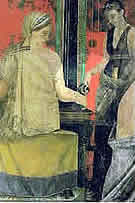
And
immediately there was in their synagogue a
man with an unclean spirit; and he [the demon]
cried out, "What have you to do with
us, Jesus
of Nazareth? ... But
Jesus rebuked him, saying, "Be silent,
and come out of him!" And
the unclean spirit, convulsing him and crying
with a loud voice, came out of him." uTtThe
youth was, without knowing it, possessed by
a devil [daimon];
for he would laugh at things that no one else
laughed at, and then he would fall to weeping
for no reason at all, and he would talk and
sing to himself. Apollonius
addressed him with anger, as a master might
a shifty, rascally, and shameless slave and
so on, and he ordered him to quit the young man...
" |
 |
||
|
Was Christianity new? Was Christianity unique? Let's talk about demons. Pagans had demons. Christians had demons. Right there in the bible, Christianity had demons. What you'll learn here is Pagans had demons first; Christians had demons second.
Well, ancient Mediterranean Pagan culture also believed in demons. For centuries before Jesus, people around the Mediterranean had the concept of demons. So, did the first Christians make up the idea of demons all on their own? Or did they borrow —absorb— the idea from ancient Mediterranean culture? Before you answer, let me mention that the earliest Christians said explicitly they believed in the Pagan demons. So, do you think Christianity borrowed the idea of Pagan demons from the Pagans who said, "There are demons"? Or did Christianity come up with the idea of Pagan demons all on its own? Are Christian ideas new and unique, or did Christianity borrow ideas from Paganism? |
 Stop.
Go slow. The first Christians believed
in demons. Demons. They believed in demons.
They actually believed there are actual beings
that live inside people and cause illness.
That think, and hear, and talk, and move around,
and do stuff. The first Christians had the
idea, the concept of demons. How can that
be? Where can that idea have come from?
Stop.
Go slow. The first Christians believed
in demons. Demons. They believed in demons.
They actually believed there are actual beings
that live inside people and cause illness.
That think, and hear, and talk, and move around,
and do stuff. The first Christians had the
idea, the concept of demons. How can that
be? Where can that idea have come from? |
The Greek word was
|

 ,
which English-letterates as "daimon."
How daimon translates depends on context.
Sometimes daimon meant
,
which English-letterates as "daimon."
How daimon translates depends on context.
Sometimes daimon meant 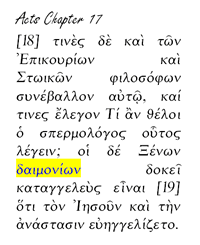 "God,"
as in one of the top rank Olympian Gods.
In the New Testament book Acts 17:18, Jesus
is called a demon. Sometimes daimon
is "demi-god," or "divinity,"
sometimes it's "guardian spirit".
Lucky people were "eu-daimon,"
well-demoned. Unlucky people were "kako-daimon,"
bad-demoned. Sometimes daimon was the soul
of the dead, sometimes it was a folk-religion
magical being—and some of those folk-religion
beings are the evil spirit you have in mind
when you hear "demon."
"God,"
as in one of the top rank Olympian Gods.
In the New Testament book Acts 17:18, Jesus
is called a demon. Sometimes daimon
is "demi-god," or "divinity,"
sometimes it's "guardian spirit".
Lucky people were "eu-daimon,"
well-demoned. Unlucky people were "kako-daimon,"
bad-demoned. Sometimes daimon was the soul
of the dead, sometimes it was a folk-religion
magical being—and some of those folk-religion
beings are the evil spirit you have in mind
when you hear "demon." 
|
Let's start with two demon stories, one pagan, one Christian. Read closely, note the shared features. Prepare to be amazed. A Pagan demon. Here's the story of a meeting between a Pagan demon and the Pythagorean teacher-sage Apollonius of Tyana. Apollonius lived in the first century AD; after He died, He was worshiped as a God. This history about Him was written in the third century AD, from notes made by one of His disciples. |
Apollonius was with some people, discussing a point of sacred ritual, when he was interrupted by a young man who was, I'll be blunt, an asshole. Always shouting at the wrong time. Being licentious. You know the type. Anyhow, Apollonius is talking and the young
guy butts in, real loud like, with a coarse
voice. And right away Apollonius,
who has this divine power about Him, sees
it's not the young lad who's
the asshole, it's a demon [ |
|
And sure enough, the kid did have a demon in him. And it was the demon that made him laugh, and cry, and sing and generally act crazy. Don't that beat all! |
|
And as soon as Apollonius spotted him, the demon knew it, and started to cry out, and talk with Apollonius and bargain with Him about leaving the young man.
|
|
But Apollonius, he didn't need to bargain. He just commanded that daimon to LEAVE! And the demon left, performing a little miracle on the way.
|
|
After which the young man turned out to be a swell fellow. I never saw it coming. How about you?
And the man who Apollonius fixed up, demon wise, becomes His follower. |
But the
young man rubbed his eyes as if he had just
woke up, and
he looked towards the rays of the sun, and
assumed a modest aspect, as all had their
attention concentrated |
|
Philostratus,
The Life of Apollonius of Tyana, 4.10 (217
AD), -- which you can find in: Conybeare,
F. C. Philostratus I: The Life of Apollonius
of Tyana, Books I - V (Loeb Classical Library
#16) (2000), pg. 389- 91] |
 =
daimon].
=
daimon]. Now
while he [
Now
while he [ And
in fact the youth was, without knowing
it,
And
in fact the youth was, without knowing
it,  But
But on
him ;
on
him ;|
Now here's a story about Jesus and a demon. Jesus lived in the first century AD; after He died, He was worshiped as a God. Whoever wrote this story didn't sign his name, and didn't say when he wrote it, so it's hard to be sure of its date. Our first atestation of this writing dates from about 130 AD, when some version of it (now lost) was offered up as part of a new sacred text—a new testament—by a heretic named Marcion. Here we go, from the Gospel of Luke... |
So Jesus comes to town, and right away he meets this man who has demons inside him. The demons make the man go around with no clothes, and live out in the cemetery. They make him act crazy. |
|
Right away Jesus, who had this divine power about
Him, knew about the demons. And the demons, who had
this divine power about them, knew He knew. And as soon as |
|
|
But Chatting with demons. |
|
And the demons left, performing a little miracle on the way.
After which the man turns out to be a swell fellow. I never saw it coming. How about you? |
32 Now a large herd of swine was feeding
there on the hillside; and they begged him
to let them enter these. So he gave them leave.
33 Then the
demons came out of the man and entered the
swine, and the herd rushed
down the steep bank into the lake and were
drowned. 34 When the herdsmen saw
what had happened, they fled, and told it
in the city and in the country. 35 Then people
went out to see what had happened, and they
|
And the man who |
38 The man from whom the demons had gone begged that he might be with him; but he sent him away, saying, 39 "Return to your home, and declare how much God has done for you." And he went away, proclaiming throughout the whole city how much Jesus had done for him. |
 |
"Luke," the unknown author of the
Gospel of Luke, 8:22-39, RSV
|
 26
Then they arrived at the country of the Ger'asenes, which is opposite
Galilee. 27 And as he [
26
Then they arrived at the country of the Ger'asenes, which is opposite
Galilee. 27 And as he [Let's recap. You now know Pagans had demons. Pagan demons could live inside people, and make them crazy. Pagan demons could be spotted by divine men. Pagan demons could tell when they'd be spotted by a divine men. Pagan demons talked to divine men. Divine men commanded Pagan demons to leave the body of the people they inhabited. And the Pagan demons left. Performing a little miracle on the way out. You also know You also know putting a line through Wow. |
| Greggy's Guesses |
|
Theology of demons, rationalism fail |
Demons
in the bible |
|
Here's a demon story from the Gospel of Mark. If there was every any question that the Christian idea of demons was identical to the Pagan idea of demons, this passage from the Word of God should set doubters straight. God, beaming His thoughts through the magical pen of "Mark," says quite clearly, "the woman was a Greek." Not a Jew. Not a Christian. A Greek. And she knew, without Jesus or anyone cluing her in, exactly how demons worked. They caused disease. And divine men could cast them out. Greek / Pagan ideas about demons were identical with Jewish/ Christian ideas about demons. The bible says so. Lets not have any more of that "Christianity is new and unique" talk, please.
|
|
 24
And from there he arose and went away to the
region of Tyre and Sidon. And he entered a
house, and would not have any one know it;
yet he could not be hid. 25 But immediately
a woman, whose
24
And from there he arose and went away to the
region of Tyre and Sidon. And he entered a
house, and would not have any one know it;
yet he could not be hid. 25 But immediately
a woman, whose |
Again from the Gospel of Mark. Another man with a spirit/ demon inside him. The spirit recognizes Jesus. Cries out. Bargains. Gets thrown out. |
|
|
Jesus casts out many demons that are causing disease.
Luke tells this same story in Gospel of Luke, 4:31- 44. I'll spare you the repetition.
|
29 And immediately
he left the synagogue, and entered the house of Simon and Andrew, with
James and John. 30 Now Simon's mother-in-law
lay sick with a fever, and immediately they told him of her.
31 And he came and took her by the hand and lifted her up, and
the fever left her; and she served them. 32 That evening, at
sundown, they brought to him all
who were sick or possessed with demons. 33 And the whole city
was gathered together about the door. 34 And he healed
many who were sick with various diseases, and cast out many demons;
and he would not permit the demons to speak, because they knew him.
|
|
From the Gospel of Matthew, a demon causes epilepsy. The ancients called epilepsy "the divine disease," because it was known to be caused by divine [daimon] possession.
Jesus rebukes the demon. The demon left. The boy was cured.
|
|
|
In this passage from the Gospel of Matthew, a little demon casting serves to bring up a point of theology.
[BTW, did you notice the plot hump "Matthew" gets around by invoking Jesus' magical mind reading ability? For more such, see Phony Quotes]
|
|
|
John the Baptist acted crazy. On account of which, people though he had a demon in him. Demon possession was part of ancient folk-religion. |
|
|
Jesus cures disease by casting out evil spirits.
|
|
Pagan
demons |
|
Daimons are older than writing. We know that because in the oldest surviving Greek writing, Homer's Iliad and Odyssey, from the 8th century BC, there they are. This bit is from the Iliad. Aphrodite is one of the big shot Olympian Gods. And, says Homer, she is a daimon. One meaning of "daimon" is God.
|
But Aphrodite
caught up Paris
380 
|
|
For Homer, daimon was also what Zeus was.
|
But Teukros picked up
another arrow for bronze-helmed
|
|
In fact, the Olympian Gods in general were described as "daimons" |
Then in answer again
spoke Achilleus of the swift feet: 215 |
|
But don't get the idea that in Homer's day "daimon" just meant "God." It didn't. For Homer, daimon was also an otherwise unnamed supernatural force that drove men in battle. |
Now by the ships
others fought in their various places
|
|
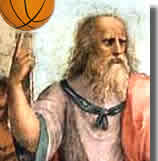
Plato has a whole theory of daimons (I told you this was cool stuff), but I won't inflict it all on you.
|
[27c] Is there
anyone who believes spiritual things exist,
but does not believe in spirits?
“There is not.” Thank you for
replying reluctantly when forced by these
gentlemen. Then you say that I believe in
spiritual beings, whether new or old, and
teach that belief; but then I believe in spiritual
beings at any rate, according to your statement,
and you swore to that in your indictment.
But if I believe in spiritual beings, it is
quite inevitable that I believe also in spirits;
is it not so? It is; for I assume that you
agree, since you do not answer. But do
we not think the spirits are [27d] gods or
children of gods? Yes, or no? “Certainly.”
Then if I believe in spirits, as you say,
if spirits are a kind of gods, that would
be the puzzle and joke which I say you are
uttering in saying that I, while I do not
believe in gods, do believe In gods again,
since I believe in spirits; but if, on the
other hand, spirits are a kind of bastard
children of gods, by nymphs or by any others,
whoever their mothers are said to be, what
man would believe that there are children
of gods, but no gods? It would be just as
absurd [27e] as if one were to believe that
there are children of horses and asses, namely
mules, but no horses and asses. |
 For
For
|
And >>
Thinking this got Socrates killed.
|
[24b] I will try to
defend myself next. So once more, as if these
were another set of accusers, let us take
up in turn their sworn statement. It is about
as follows: it states that Socrates
is a wrongdoer because he corrupts the youth
and does not believe in the gods the state
believes in, but in other 24c] new
spiritual beings. [hetera daimonia kaina] |
One of the things Plato is famous for is having a whole theory of daimons, but I won't inflict it all on you. You're welcome. |
How about in Jesus time? In the first and second centuries AD, people understood that divinity had a hierarchy. There were the big Gods, like Zeus, Dionysus, Isis, Yahweh. Under them were demi-gods, daimons. Under them were Heroes, men whose amazing deeds had been rewarded with immortality. Under them were regular people. |
|
Here's Plutarch (c. 50 AD - c. 120 AD) describing
the divine hierarchy.
I'm telling you about Jesus' time, but notice that the daimons in the divine hierarchy. business dates all the way back to Hesiod, in the 7th century BC. |
"[I]t seems to me, those persons have resolved more and greater perplexities who have set the race of demigods [daimonon] midway between gods and men," and have discovered a force to draw together, in a way, and to unite our common fellowship-whether this doctrine comes from the wise men of the cult of Zoroaster, or whether it is Thracian and harks back to Orpheus, or is Egyptian, or Phrygian, as we may infer from observing that many things connected with death and mourning in the rites of both lands are combined in the ceremonies so fervently celebrated there. Among the Greeks, Homer, moreover, appears to use both names in common and sometimes to speak of the gods as demigods [daimonas] ; but Hesiod was was the first to set forth clearly and distinctly four classes of rational beings : gods, demigods, heroes, in this order, and, last of all, men ; and as a sequence to this, apparently, he postulates his transmutation, the golden race passing selectively into many good divinities, and the demigods into heroes. |
|
|
" Others postulate a transmutation for bodies and souls alike ; in the same manner in which water is seen to be generated from earth, air from water, and fire from air, as their substance is borne upward, even so from men into heroes and from heroes into demigods [daimonas] the better souls obtain their transmutation. But from the demigods a few souls still, in the long reach of time, because of supreme excellence, come, after being purified, to share completely in divine qualities. But with some of these souls it comes to pass that they do not maintain control over themselves, but yield to temptation and are again clothed [page 381] with moral bodies and have a dim and darkened life, like mist or vapor |
|
Plutarch, The Obsolescence of Oracles, 414 F - 415 C (1st century AD), -- which you can find in: Babbitt, Frank. Plutarch Moralia, Loeb, Volume 5 (1936/ 1999), pg. 377- 9 |
As demi-gods, demons were worshiped. |
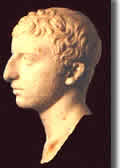
| Apollonius of Tyana became divine, and was worshiped. |
" And I," said Apollonius, " my good friend, understand all languages, though I never learnt a single one." The native of Ninevah was astonished at this answer, but the other replied: " You need not wonder at my knowing all human languages ; for, to tell you the truth, I also understand all the secrets of human silence." Thereupon the Assyrian worshipped him, when he heard this, and regarded him as a demon; and he stayed with him increasing in wisdom and committing to memory whatever he learnt. Philostratus,
The Life of Apollonius of Tyana, 4.10 (217
AD), -- which you can find in: Conybeare,
F. C. Philostratus
I: The Life of Apollonius of Tyana, Books
I - V (Loeb
Classical Library #16) (2000), pg. 53 |
|
Remember Socrates, the 5th century BC Greek fellow who had his own personal daimon? That idea caught on. And lasted. Here's Porphyry, in the third century AD, describing a ceremony in which the famous neo-platonic philosopher Plotinus called up his own personal demon. Plotinus was so cool, his personal daimon turned out to be a full fledged God. Plotinus was so impressed, he wrote a book about it. Who wouldn't? |
Plotinus had special gifts from his birth onwards. There was an Egyptian priest who came to Rome and met him through a friend. This priest offered to give a demonstration of his science and asked him to come to attend an evocation of his familiar spirit. [Professor Beard notes: "The Greek word is daimon, which sometimes corresponds to our 'demon', but is not necessarily a hostile spirit; the idea of a daimon attached to the individual goes back to Plato."] Plotinus was happy to agree. It was in the Isis temple that the evocation took place, because that, according to the Egyptian priest, was the only place he could find in Rome that was 'pure'. The spirit was conjured and asked to reveal himself, but it was not a spirit [daimon] that appeared, but a god. The Egyptian cried out: 'You are blessed who have as your familiar a god and not a spirit of the lower orders.' There was no chance to ask any questions of the
apparition, nor even to look at it for long, because another friend
who was there, and who was holding some birds as an insurance, strangled
them, whether because he was jealous or terrified. Since
Plotinus had a divine being as his familiar, he concentrated
on it for a time with his divine eye. This experience caused him to
write a book trying to explain the differences between familiars; it
was called On the Spirit that Allotted Us to Himself. |
Demons
in pre-Christian Judaism |
Once upon a time, a young lad named Tobias was walking along the river, when a fish jumped up and tried to swallow him.
And the angel (did I mention there was an angel?) said, "Cut out the fish's liver, heart, and gall." So Tobias did. |
Tobit, Chapter 6 |
The angel explained: The smoke from burning fish heart and liver will drive away demons, and cure disease. |
6: Then the young man said to the angel, "Brother Azarias, of what use is the liver and heart and gall of the fish?" 7: He replied, "As for the heart and liver, if a demon or evil spirit gives trouble to any one, you make a smoke from these before the man or woman, and that person will never be troubled again. 8: And as for the gall, anoint with it a man who has white films in his eyes, and he will be cured." |
Scene 2. According to the Law of God, Tobias is entitled to inherit the girl Sarah. |
9: When they approached Ecbatana, 10: the angel said to the young man, "Brother, today we shall stay with Raguel. He is your relative, and he has an only daughter named Sarah. I will suggest that she be given to you in marriage, 11: because you are entitled to her and to her inheritance, for you are her only eligible kinsman. 12: The girl is also beautiful and sensible. Now listen to my plan. I will speak to her father, and as soon as we return from Rages we will celebrate the marriage. For I know that Raguel, according to the law of Moses, cannot give her to another man without incurring the penalty of death, because you rather than any other man are entitled to the inheritance." |
Trouble is, Sarah has already been given to seven husbands, and they all died "in the bridal chamber," if you know what I mean. Why? They were all killed by a demon who is in love with Sarah. You got any guesses where this story is headed? |
13: Then the young man said to the angel, "Brother Azarias, I have heard that the girl has been given to seven husbands and that each died in the bridal chamber. 14: Now I am the only son my father has, and I am afraid that if I go in I will die as those before me did, for a demon is in love with her, and he harms no one except those who approach her. So now I fear that I may die and bring the lives of my father and mother to the grave in sorrow on my account. And they have no other son to bury them." |
Don't worry, said the angel to Tobias, use the magic fish liver. |
15: But the angel said to him, "Do you not remember the words with which your father commanded you to take a wife from among your own people? Now listen to me, brother, for she will become your wife; and do not worry about the demon, for this very night she will be given to you in marriage. 16: When you enter the bridal chamber, you shall take live ashes of incense and lay upon them some of the heart and liver of the fish so as to make a smoke. 17: Then the demon will smell it and flee away, and will never again return. And when you approach her, rise up, both of you, and cry out to the merciful God, and he will save you and have mercy on you. Do not be afraid, for she was destined for you from eternity. You will save her, and she will go with you, and I suppose that you will have children by her." When Tobias heard these things, he fell in love with her and yearned deeply for her. |
Chapter 7 is all setup. Skip is if you want. |
Chapter 7 6: Then Raguel sprang up and kissed him and wept. 7: And he blessed him and exclaimed, "Son of that good and noble man!" When he heard that Tobit had lost his sight, he was stricken with grief and wept. 8: And his wife Edna and his daughter Sarah wept. They received them very warmly; and they killed a ram from the flock and set large servings of food before them. Then Tobias said to Raphael, "Brother Azarias, speak of those things which you talked about on the journey, and let the matter be settled." 9: So he communicated the proposal to Raguel. And Raguel said to Tobias, "Eat, drink, and be merry; 10: for it is your right to take my child. But let me explain the true situation to you. 11: I have given my daughter to seven husbands, and when each came to her he died in the night. But for the present be merry." And Tobias said, "I will eat nothing here until you make a binding agreement with me." 12: So Raguel said, "Take her right now, in accordance with the law. You are her relative, and she is yours. The merciful God will guide you both for the best." 13: Then he called his daughter Sarah, and taking her by the hand he gave her to Tobias to be his wife, saying, "Here she is; take her according to the law of Moses, and take her with you to your father." And he blessed them. 14: Next he called his wife Edna, and took a scroll and wrote out the contract; and they set their seals to it. 15: Then they began to eat. 16: And Raguel called his wife Edna and said to her, "Sister, make up the other room, and take her into it." 17: so she did as he said, and took her there; and the girl began to weep. But the mother comforted her daughter in her tears, and said to her, 18: "Be brave, my child; the Lord of heaven and earth grant you joy in place of this sorrow of yours. Be brave, my daughter." |
|
And Tobias did inherit Sarah, and go to her bridal chamber, but he didn't die, because he burned the fish liver and heart, and the smoke drove the demon away. |
Chapter 8 |
And they all lived happily ever after. |
Old Testament, Book of Tobitt |
Like the Greeks, like the Romans, like the Egyptians, Thracians, Macedonians, Cartheginians, Phonecians, like everyone in ancient culture, pre-Christian Jews believed in magic demons. Demons that could cause death and disease. Demons that could be driven away by magic spells and incantations. |
|
Jews and Romans in 1st century AD Judea believed in demons, and demons causing disease, and casting out demons, and demons doing a little miracle on the way out. |
8.2.5. Now the sagacity and wisdom which God had bestowed on Solomon was so great, that he exceeded the ancients; insomuch that he was no way inferior to the Egyptians, who are said to have been beyond all men in understanding; nay, indeed, it is evident that their sagacity was very much inferior to that of the king's. . ... |
|
God also enabled him to learn that skill which expels demons, (4) which is a science useful and sanative to men. He composed such incantations also by which distempers are alleviated. And he left behind him the manner of using exorcisms, by which they drive away demons, so that they never return; |
|
|
|
| And when Eleazar
would persuade and demonstrate to the spectators that he had such a
power, he set a little way off a
cup or basin full of water, and commanded the demon, as he went out
of the man, to overturn it, and thereby to let the spectators
know that he had left the man... |
 and
this method of cure is of great force unto this day; for
and
this method of cure is of great force unto this day; for | |
I call upon
you, demon, whoever
you are, and I charge you from this hour, from this day, from this moment
-- torment and strike down the horses of the Green and White
[factions]. Strike down the charioteers Clarus and Felix and Primulus
and Romanus, and cause them to crash, and leave no life in them. I call
upon you by the one who loosed you for periods of time, the god of sea
and air. |
| |
The Pythagoreans
also assert that the whole air is full of souls, and that these are
those that are accounted daimons
or heroes. They are the ones that send down among men
dreams, and tokens of disease
and health; the latter not being reserved to human beings, but being
sent also to sheep and cattle as well. They are concerned with purifications,
expiations, and all kinds of divinations,
oracular predictions, and the like. |
Good Books for this section
| Demonology
of the Early Christian World
  |
What you'll find:
All based on a detailed scholarly review and presentation of the primary ancient evidence. Highly, highly recommended.
|

 You can buy this book through Amazon, but I've never seen it
there for less than $85. Ouch. See if your local library can get a copy
from a university, through inter-libary loan.
You can buy this book through Amazon, but I've never seen it
there for less than $85. Ouch. See if your local library can get a copy
from a university, through inter-libary loan.

|
Miracles
in Greco-Roman Antiquity
|
Lousy with miracles Like chocolate chips in mama's cookies, miracles were a basic ingredient in ancient people's understanding of how the world works. Every bite—another miracle. The ancient world was lousy with miracles. Includes a long section with Pagan, Jewish, and Christian passages relating to demons, demon possession, demon exorcism, and the god-demon-hero-man hierarchy. Well organized, easy to read. Highly recommended.
|


| |
|